
Hydraulic hose fittings types: identify and choose correctly

The six fitting families you will encounter on most UK agricultural and mobile plant hydraulic systems are JIC (37° flare), ORFS (O‑ring face seal), BSPP (British Standard Pipe Parallel), BSPT (British Standard Pipe Tapered), NPT (National Pipe Taper), and metric/DIN variants. Banjo fittings and quick‑connect couplers cover the remaining specialist cases. The one‑line selection rule: match the sealing method first, then the hose dash size, then the duty cycle. Get the sealing method wrong and no amount of torque will stop a leak.
Before you touch any fitting, run through this checklist:
- Depressurise the system fully and isolate the circuit before measuring or disconnecting anything.
- Identify the sealing method (tapered thread, metal‑to‑metal flare, or O‑ring) before reaching for a spanner.
- Record the hose dash size, thread OD, thread pitch, and seat angle.
- Match pressure and temperature ratings to your system’s working parameters.
- Confirm compatibility with existing ports before ordering.
Safety first, always. Hydraulic systems can hold residual pressure long after the engine stops. Failure to depressurise before disconnecting a line risks serious injection injury — a wound that looks minor on the surface but can cause tissue destruction within hours. Never skip this step.
Table of Contents
- Why the sealing method matters more than the thread
- Common hydraulic hose fitting types: identification, sealing and uses
- Thread standards and sealing principles: quick reference
- How to identify the hydraulic fitting you have
- How to choose the right fitting for your system
- Sourcing in the UK: how Schwarzebulle helps you get the right part
- Common mistakes, safety warnings, and maintenance tips
- Key takeaways
- What technicians actually learn the hard way
- Schwarzebulle stocks the tractor hydraulic parts you need, ready to dispatch
- Useful references and recommended standards
Why the sealing method matters more than the thread
A hydraulic hose fitting does two jobs: it clamps the hose to the port mechanically, and it creates a pressure‑tight seal. Those two jobs are not always done by the same surface, and confusing them is the root cause of most hydraulic leaks on farm machinery.
Hydraulic fittings rely on three distinct sealing principles: tapered thread interference, metal‑to‑metal flare contact, and O‑ring compression. In a tapered thread system such as NPT or BSPT, the thread itself is the seal — the flanks wedge together as you tighten, and a thread sealant (PTFE tape or anaerobic compound) fills the remaining micro‑gaps. In a flare system such as JIC 37° or DIN 24°, the thread is purely mechanical; the actual seal is the angled metal seat pressing against a matching cone. In an O‑ring system such as ORFS or ORB (O‑ring boss), a rubber O‑ring compressed between flat or recessed faces does all the sealing work.
The thread is not always the seal. Misidentifying the sealing principle — for instance, applying thread sealant to a JIC flare fitting in the belief that the thread seals — leads to dangerous assembly errors and persistent leaks.
Why does this matter for selection? Because mixing sealing principles is one of the most common causes of hydraulic failure in workshops. A BSPP parallel thread will not seal by thread interference; it needs a bonded seal or O‑ring at the face. An ORFS fitting torqued without its O‑ring in place will leak regardless of how tight it is. And a tapered NPT fitting threaded into a BSPP port will cross‑thread or strip before it ever seals.
Pro Tip: Before ordering any replacement fitting, photograph the port sealing face and the existing fitting’s seat. The image tells you instantly whether you are dealing with a flat face (ORFS), a cone (JIC/DIN), or a plain thread (tapered). A photo is worth more than a verbal description when you are on the phone to a parts supplier.
Leak risk, reassembly repeatability, and cross‑standard compatibility all flow from this single decision. Get the sealing principle right and the rest of the selection process becomes straightforward.
Common hydraulic hose fitting types: identification, sealing and uses
Agricultural and mobile plant hydraulic systems commonly use JIC, ORFS, NPT, and BSP fittings, but the full picture is wider. Here is a practical taxonomy for workshop identification.
JIC / SAE 37° flare
Visual ID: 37° cone seat on the male end; the nut has a hex body and a swaged or threaded collar. The seat angle is the key distinguishing feature — measure it with a protractor or flare angle gauge.
Sealing method: Metal‑to‑metal contact between the 37° male cone and the matching female seat. The thread clamps; the flare seals.
Common dash sizes: #4 (1/4 in) through #20 (1‑1/4 in).
Typical uses: Fixed hydraulic lines on tractors, loader arms, and implements. Widely used on North American OEM equipment and common on older UK machinery. JIC fittings can be reassembled in principle, but repeated disassembly risks deforming the flare seat, making ORFS the better choice where frequent maintenance is expected.
ORFS (O‑ring face seal)
Visual ID: Flat face on the male end with a recessed groove holding an O‑ring. No cone or taper on the sealing face.
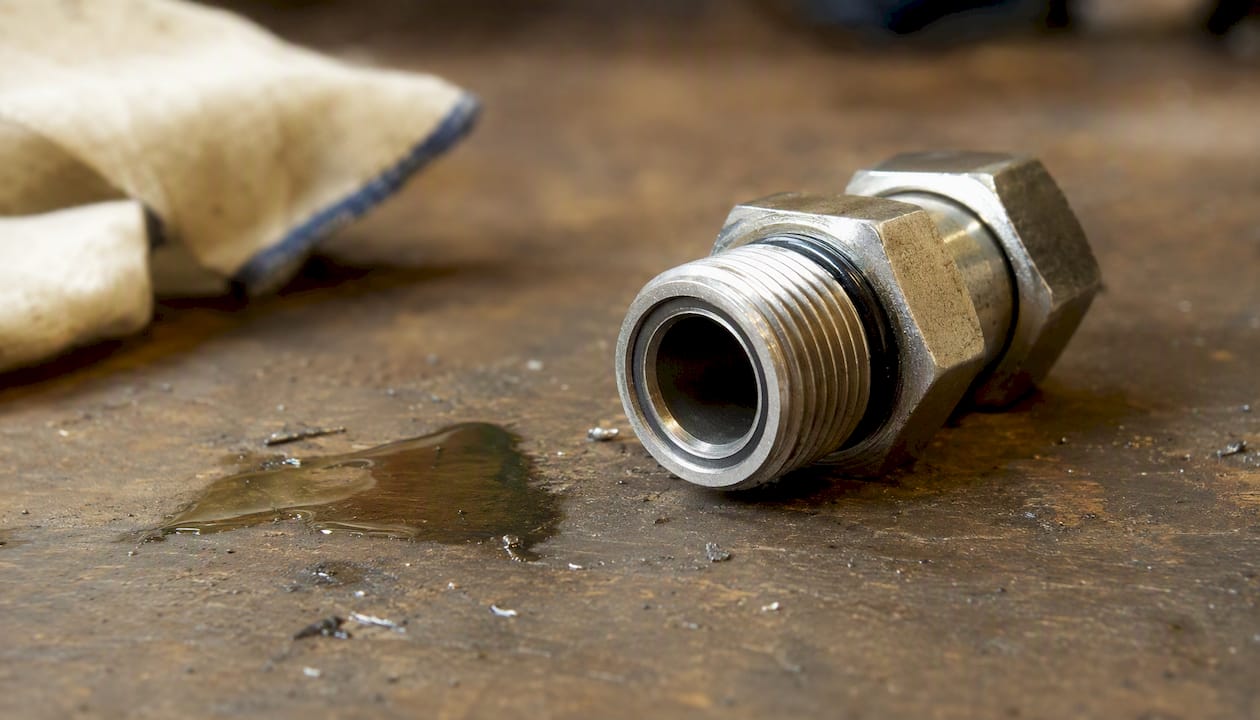
Sealing method: O‑ring compressed between the flat male face and a flat female port face. Highly reliable under vibration.
Common dash sizes: #4 through #20, matching JIC dash sizing.
Typical uses: OEM high‑pressure lines on modern tractors and combine harvesters; any application where vibration or frequent maintenance demands a leak‑resistant, repeatable connection. ORFS is the preferred choice for new builds and service replacements on high‑cycle lines.
ORB (O‑ring boss)
Visual ID: Straight (parallel) thread with a recessed O‑ring groove behind the thread. The O‑ring seats against the boss face of the port, not a flat coupling face.
Sealing method: O‑ring compressed against the machined boss face as the fitting is tightened.
Typical uses: Port connections on hydraulic valves, pumps, and cylinders. Common on SAE‑standard equipment.
BSPP (British Standard Pipe Parallel)
Visual ID: Parallel thread (Whitworth thread form); the thread does not taper. Requires a bonded seal (Dowty washer) or O‑ring at the face to seal.

Sealing method: Face seal via bonded washer or O‑ring, not thread interference.
Common sizes: 1/4 BSP through 2 BSP.
Typical uses: Extremely common on UK and European agricultural equipment, hydraulic valves, and manifolds. The dominant thread standard on British‑built tractors.
BSPT (British Standard Pipe Tapered)
Visual ID: Tapered thread (same Whitworth form as BSPP but with a taper). Visually similar to NPT but with a different taper angle and thread pitch.
Sealing method: Thread interference, usually with PTFE tape or thread sealant.
Typical uses: Low‑ to medium‑pressure ports on older UK equipment; less common than BSPP on modern hydraulic systems.
NPT / NPTF (National Pipe Taper)
Visual ID: Tapered thread with a 60° thread angle (versus BSPT’s 55°). The taper is 1:16 on diameter.
Sealing method: Thread interference; NPT threads seal by thread interference and typically require a sealant. They are not interchangeable with BSPP or flare/O‑ring systems.
Typical uses: North American OEM equipment, some imported tractors, and hydraulic accessories. Less common on UK‑built machinery but frequently encountered on attachments.
Metric / DIN fittings
Visual ID: Metric thread pitch (e.g. M12×1.5, M14×1.5, M16×1.5); DIN 24° cone fittings have a 24° seat angle versus JIC’s 37°. The two look similar but are not interchangeable.
Sealing method: DIN 24° uses metal‑to‑metal cone contact; metric face seal variants use an O‑ring or bonded washer.
Typical uses: European OEM tractors (Fendt, Deutz‑Fahr, Claas), hydraulic cylinders, and German‑manufactured plant.
Banjo fittings
Visual ID: A hollow bolt passing through a cylindrical banjo body; seals with copper or aluminium crush washers on each side.
Sealing method: Crush washers compressed against flat faces.
Typical uses: Tight‑space applications — fuel injection, brake lines, and low‑pressure hydraulic circuits where a 90° or 180° port is needed in a confined area.
Quick‑connect couplers
Visual ID: Push‑to‑connect or lever‑operated bodies; typically colour‑coded or sized by ISO standard.
Sealing method: Internal valve and O‑ring; no thread engagement needed for connection.
Typical uses: Quick‑connect couplers conforming to ISO 5675 and ISO 7241‑1 are the standard connection for tractor attachment interfaces because they allow repeated hand assembly without tools. Permanent lines use JIC or ORFS.
Elbows, swivels, and straight adaptors
These are not distinct sealing types but rather geometric configurations of the fitting families above. A 90° JIC elbow seals identically to a straight JIC fitting; a swivel allows the hose to rotate without twisting. Choose the geometry based on routing constraints, not sealing requirements.
Compatibility summary:
| Fitting type | Sealing method | Typical uses / best for | Compatibility issues | Reassembly repeatability | Pressure / temperature suitability |
|---|---|---|---|---|---|
| JIC / SAE 37° flare | Metal‑to‑metal flare | Fixed tractor lines, loader arms | Do not mix with DIN 24° | Moderate — flare can deform | High pressure; standard temperature range |
| ORFS | O‑ring face seal | OEM high‑pressure, vibration‑prone lines | Not interchangeable with JIC | High — O‑ring replaceable | High pressure; wide temperature range |
| ORB | O‑ring boss | Valve and pump ports | SAE‑specific port thread | High — O‑ring replaceable | High pressure |
| BSPP | Face seal (bonded washer / O‑ring) | UK / European equipment, manifolds | Parallel thread — needs face seal | High with new washer | Medium to high pressure |
| BSPT | Tapered thread interference | Older UK equipment, low‑pressure ports | Not interchangeable with BSPP | Low — thread sealant needed | Low to medium pressure |
| NPT / NPTF | Tapered thread interference | North American OEM, imported attachments | Not interchangeable with BSPT or BSPP | Low — thread sealant needed | Low to medium pressure |
| Metric / DIN 24° | Metal‑to‑metal cone | European OEM tractors | Do not mix with JIC 37° | Moderate | High pressure |
| Banjo | Crush washer | Tight‑space, low‑pressure circuits | Single‑use washers | Low — washers must be replaced | Low to medium pressure |
| Quick‑connect | Internal O‑ring / valve | Attachment interfaces, frequent changes | ISO 5675 / ISO 7241‑1 series compatibility | Very high | Medium pressure |
Thread standards and sealing principles: quick reference
Understanding the thread form tells you what standard you are working with. Understanding the sealing principle tells you how to assemble it correctly. These are two separate questions.
| Thread standard | Thread form | Taper? | Sealing principle | Common port standard |
|---|---|---|---|---|
| BSPP (G thread) | Whitworth 55° | No (parallel) | Face seal — bonded washer or O‑ring | ISO 228; common on UK / EU tractors |
| BSPT (R thread) | Whitworth 55° | Yes (1:16) | Thread interference + sealant | Older UK equipment |
| NPT | UN 60° | Yes (1:16) | Thread interference + sealant | North American OEM |
| NPTF | UN 60° | Yes (1:16) | Thread interference — dry seal | North American OEM (higher integrity) |
| JIC / SAE 37° | UN 60° | No | Metal‑to‑metal 37° flare | SAE J516; mobile equipment globally |
| DIN 24° | Metric | No | Metal‑to‑metal 24° cone | DIN 2353; European OEM |
| ORFS | UN 60° | No | O‑ring face seal | SAE standard; OEM high‑pressure |
| ORB | UN 60° | No | O‑ring boss (port face) | SAE standard; valve / pump ports |
| Metric BSP equiv. | Metric | No | Face seal / O‑ring | ISO standard; European hydraulics |
The critical compatibility pitfall is assuming that because two fittings thread together, they will seal. BSPP and BSPT share the same Whitworth thread form, so a BSPT male will thread into a BSPP female port — but it will not seal correctly because the parallel port is not designed for tapered thread interference. Similarly, a JIC 37° male will physically engage a DIN 24° female to some degree, but the seat angles do not match and the assembly will leak under pressure.
Where mixing standards is unavoidable, use a purpose‑made adaptor that converts at one end and presents the correct sealing geometry at the other. Never rely on thread sealant to compensate for a mismatched sealing principle.
How to identify the hydraulic fitting you have
Safety checklist before you start:
- Shut down the machine and allow the engine to cool.
- Cycle all hydraulic controls to release stored pressure in accumulators and cylinders.
- Place a drip tray under the fitting area.
- Wear safety glasses and cut‑resistant gloves.
- Confirm zero pressure with a gauge on the test port if one is available.
Step‑by‑step identification sequence:
- Record the hose dash size. Hydraulic fitting sizes use the dash system in 1/16‑inch increments — a #6 fitting is 3/8 in (approximately 9.5 mm) and a #8 is 1/2 in (approximately 12.7 mm). Measure the hose inner diameter or read the dash number printed on the hose cover.
- Measure the thread OD. Use vernier calipers on the male thread’s outer diameter. This gives you the nominal thread size.
- Check the thread pitch. Use a thread pitch gauge. Note whether the thread is metric (pitch in mm) or imperial (threads per inch). This distinguishes metric DIN fittings from JIC/SAE fittings of similar OD.
- Determine taper or parallel. Hold a straight edge along the thread flanks. Tapered threads (NPT, BSPT) show a visible taper; parallel threads (BSPP, JIC, ORFS) do not.
- Inspect the seat / flare angle. Measure the seat angle with a protractor or flare angle gauge; 37° indicates JIC/SAE, 24° indicates DIN. A flat face with an O‑ring groove indicates ORFS; a flat face with no groove and a bonded washer indicates BSPP.
- Check for an O‑ring. Look for a recessed groove on the male face (ORFS) or behind the thread (ORB). If the O‑ring is missing, the fitting will not seal even if correctly assembled.
- Photograph the sealing face. A clear photograph of the port sealing face and the fitting’s seat angle speeds correct identification when consulting a parts supplier.
Measurement record template — send this to your supplier:
| Field | Your measurement |
|---|---|
| Hose dash size (e.g. | #8) |
Fill in every field before contacting a supplier. A complete record eliminates the most common cause of wrong‑part orders: ambiguous verbal descriptions of thread sizes.
How to choose the right fitting for your system
Identification tells you what you have. Selection tells you what to order. Work through this sequence before placing an order.
Selection flow:
- Step 1 — Match hose dash size. The fitting dash must match the hose dash. A #8 hose takes a #8 fitting end; mixing dash sizes creates a restriction or a leak point at the crimp.
- Step 2 — Confirm the sealing method. The fitting’s sealing principle must match the port. Use permanent fittings such as JIC or ORFS for fixed lines; use quick‑connect couplers for frequently changed attachments.
- Step 3 — Verify pressure and temperature rating. The fitting’s rated working pressure must meet or exceed the system’s maximum working pressure. Check the hose assembly’s burst factor safety margin — the SAE J516 standard sets dimensional and performance specifications for hydraulic hose fittings used with SAE J517 hoses on mobile equipment.
- Step 4 — Check hydraulic fluid compatibility. Nitrile O‑rings are standard for mineral oil; Viton (FKM) is required for phosphate ester or biodegradable fluids. Specifying the wrong elastomer causes O‑ring swelling and premature failure.
- Step 5 — Confirm routing geometry. Decide whether you need a straight, 45°, or 90° elbow, and whether a swivel end is needed to prevent hose twist during installation.
Red flags to check before ordering:
- Mismatched seat angles (37° JIC versus 24° DIN) — they look similar and will thread together but will not seal.
- Assuming a parallel BSPP port will seal on a tapered BSPT or NPT fitting without an adaptor.
- Applying PTFE tape to a JIC or ORFS fitting — the thread is not the seal, and tape can contaminate the hydraulic circuit.
- Reusing a banjo crush washer — single‑use only; a reused washer will not compress correctly.
- Ordering by thread size alone without confirming the seat angle or O‑ring groove.
Sourcing in the UK: how Schwarzebulle helps you get the right part
Getting the identification right at the bench saves time and money at the ordering stage. Before contacting any UK supplier, prepare the following:
- Completed measurement record (dash size, thread OD, pitch, seat angle, taper/parallel).
- Clear photographs of the port sealing face and the existing fitting’s seat.
- Machine make, model, and year of manufacture.
- Any OEM part numbers visible on the existing fitting or in the service manual.
Schwarzebulle stocks genuine and aftermarket tractor parts with detailed OEM cross‑referencing, which means you can search by OEM part number and find the correct replacement without having to decode every thread standard yourself. The catalogue covers compatibility information for a wide range of tractor models, and parts are dispatched quickly from the UK — useful when a machine is standing idle in the field.
OEM cross‑reference speeds correct selection. Supplying the machine make, model, and any visible part numbers allows a supplier to cross‑reference directly against OEM data, bypassing the risk of a wrong‑part order based on a verbal thread description alone.
Pro Tip: When you search Schwarzebulle’s catalogue by OEM part number, the product page lists compatibility information and fitment notes. Screenshot that page and keep it with your service records — it gives you the correct part number for the next order without repeating the measurement process.
Ask your supplier for torque specifications or a reference to the OEM service manual for the fitting type. Over‑torquing is one of the most common assembly errors, and the correct torque varies by fitting type, size, and material.
Common mistakes, safety warnings, and maintenance tips
Most hydraulic leaks on farm machinery trace back to a small set of repeatable errors. Knowing them in advance is cheaper than learning them from a failed hose.
Top mistakes:
- Mixing sealing standards. Threading a JIC male into a DIN 24° female, or a BSPT male into a BSPP port, produces an assembly that looks correct but leaks under pressure.
- Applying thread sealant to flare or O‑ring fittings. The thread is not the seal in these systems. PTFE tape fragments can block orifices and damage valve seats.
- Over‑torquing. Excess torque deforms JIC flare seats and crushes ORFS O‑rings beyond their elastic limit. Always use the manufacturer’s torque specification for the fitting size and material.
- Reusing damaged flares. A scored or oval JIC flare seat will not seal regardless of torque. Replace the fitting.
- Reusing banjo crush washers. These are single‑use components. A reused washer will not compress uniformly and will weep under pressure.
- Ignoring hose routing. Twisted or kinked hoses fail prematurely; allow adequate bend radius and use swivel fittings where the hose needs to move.
Maintenance tips:
- Inspect hose assemblies visually at every service interval. Look for weeping at crimp ferrules, cracked outer covers, and corrosion on fitting bodies.
- Replace O‑rings and bonded seals during any service that requires fitting removal — the cost of a new seal is negligible compared to a repeat repair.
- Use correct crimp specifications for the hose and fitting combination. Under‑crimping pulls off under pressure; over‑crimping cuts the hose inner tube.
- Store spare O‑rings in a sealed bag away from UV light and ozone sources (electric motors, welding equipment). Degraded O‑rings fail without warning.
- When building new hose assemblies, route hoses with a minimum bend radius of at least ten times the hose OD unless the hose manufacturer specifies otherwise.
Key takeaways
Identifying the sealing method — tapered thread, metal‑to‑metal flare, or O‑ring — is the single most important step before ordering any hydraulic hose fitting replacement.
| Point | Details |
|---|---|
| Identify the sealing method first | Tapered thread, flare, or O‑ring: getting this wrong causes leaks no amount of torque will fix. |
| Record all measurements before ordering | Note hose dash size, thread OD, thread pitch, seat angle, and whether an O‑ring groove is present. |
| Depressurise before disconnecting | Release all stored pressure and isolate the circuit before measuring or removing any fitting. |
| Match duty cycle to fitting type | Use ORFS or JIC for permanent lines; use ISO 5675 / ISO 7241‑1 quick‑connects for frequently changed attachments. |
| Use Schwarzebulle’s OEM cross‑reference | Supply machine make, model, and OEM part numbers to Schwarzebulle for fast, accurate part matching and UK dispatch. |
What technicians actually learn the hard way
The conventional wisdom says “measure twice, order once.” That is correct but incomplete. The part that trips up experienced mechanics is not the measurement — it is the assumption that a fitting which threads in must be the right fitting. On a busy farm, someone grabs a fitting from the parts bin, it threads in, it holds for a day, and then it weeps. Nine times out of ten, the thread was right but the sealing principle was wrong.
The other thing worth saying plainly: ORFS is almost always the better choice for a new build or a service replacement on a modern tractor, even when the original fitting was JIC. The O‑ring is replaceable, the flat face is easy to inspect, and the assembly is repeatable by anyone with a spanner and a torque wrench. JIC is fine on a line that never comes apart, but the moment you are servicing it regularly, the flare seat is on borrowed time.
One practical trick that saves time in the field: when photographing a port for a supplier, hold a coin next to the fitting for scale and angle the camera so the sealing face is fully lit. A blurry photo of a thread from the side tells a supplier almost nothing. A sharp image of the face, with scale, tells them everything.
Schwarzebulle stocks the tractor hydraulic parts you need, ready to dispatch
Sourcing the correct hydraulic fitting for a tractor repair should not mean a week of back‑and‑forth with a supplier who does not know your machine.
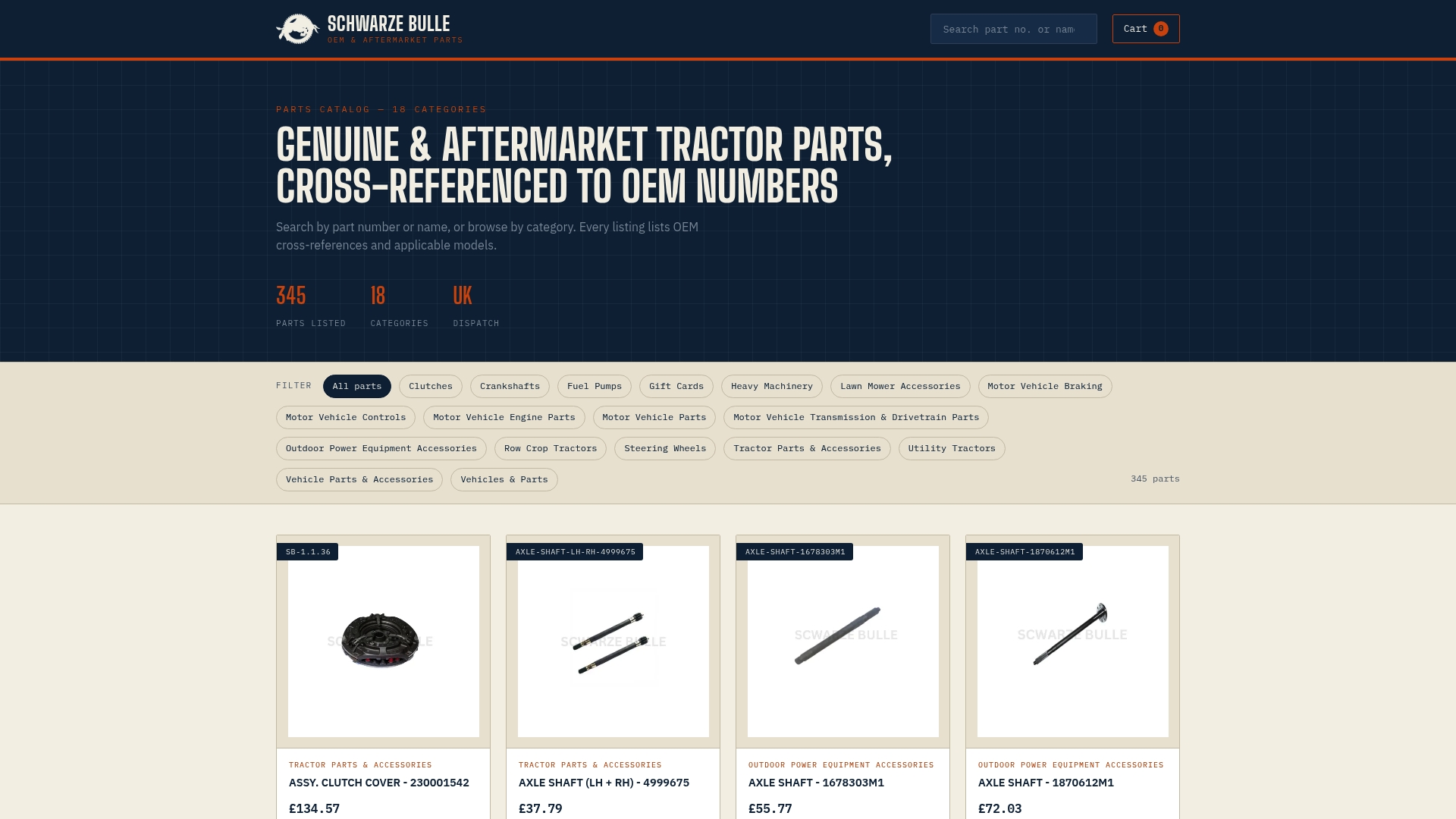
Schwarzebulle’s catalogue covers genuine and aftermarket tractor parts with full OEM cross‑referencing, so you can search by part number, machine model, or component type and get a confirmed match rather than a best guess. Parts are dispatched quickly from the UK, which matters when a loader or implement is standing idle at a critical point in the season. The hydraulic pump and related components listed in the catalogue include fitment notes and compatibility data, so you can confirm the part is correct before it leaves the warehouse.
To get the fastest, most accurate order fulfilment, bring your completed measurement record: hose dash size, thread OD, pitch, seat angle, machine make and model, and any OEM part numbers. Schwarzebulle’s team can cross‑reference against OEM data to validate fitment before dispatch. Browse the full catalogue and submit your enquiry at schwarzebulle.com.
Useful references and recommended standards
For technicians who need the full specification detail behind the identification guidance above:
- SAE J516: Hydraulic Hose Fittings Technical Standard — the primary dimensional and performance standard for hydraulic hose fittings used with SAE J517 hoses on mobile and stationary equipment.
- The complete guide to hydraulic fittings — covers sealing principles, thread standards, and compatibility warnings in detail.
- Exploring the hydraulic fittings that drive tractors — explains quick‑connect standards (ISO 5675, ISO 7241‑1) and reuse guidance for JIC and ORFS.
- Schwarzebulle tractor parts catalogue — OEM cross‑reference search, compatibility data, and UK dispatch for genuine and aftermarket tractor parts.
For OEM torque specifications and service intervals, consult the manufacturer’s service manual for your specific tractor model. ISO 228 (BSPP), ISO 7241 (quick‑connect couplers), and DIN 2353 (metric compression fittings) are the relevant British and international standards for the thread forms and fitting types covered in this guide.